

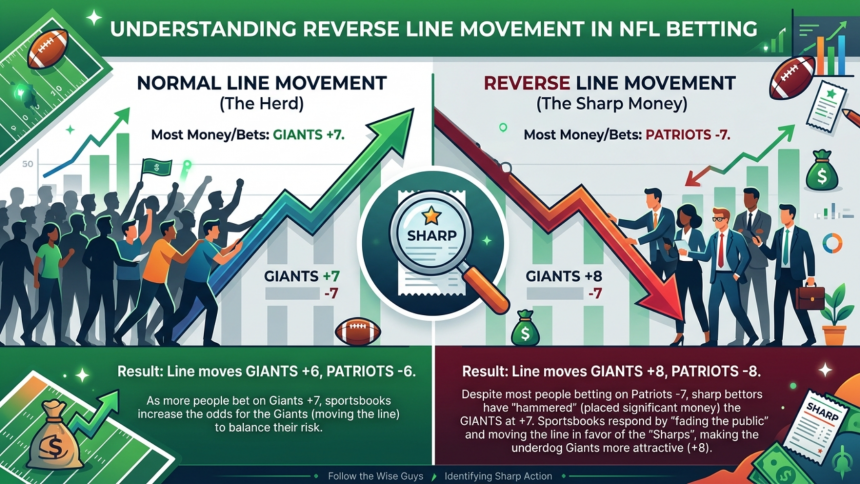
A reverse line movement is a situation in NFL betting where the betting line moves in the opposite direction of the majority of bets being placed, indicating that sharp bettors are taking the other side of the bet. This concept matters for NFL betting because it can provide valuable insights into the betting market and help bettors make more informed decisions. For example, let’s say the Green Bay Packers are playing the Chicago Bears and the point spread is initially set at Packers -7. If 70% of bets are on the Packers, but the line moves to Packers -5, this could be an example of reverse line movement. In this scenario, if a bettor had placed a $100 bet on the Bears +7 at the initial line, they would have gotten a better deal than if they had waited and placed the bet at the new line of Bears +5. This is because the bettor would have gotten 2 extra points of value, which could be the difference between winning and losing the bet. To calculate the exact dollar value of this, let’s assume the bettor wins the bet at the initial line of Bears +7 and gets a payout of $190 (including the initial $100 stake). If the bettor had placed the bet at the new line of Bears +5, they would have needed the Bears to cover by 2 fewer points to win the same amount of money. This means that the reverse line movement would have cost the bettor $20 in potential winnings, assuming a standard 10% vig.
Understanding Reverse Line Movement

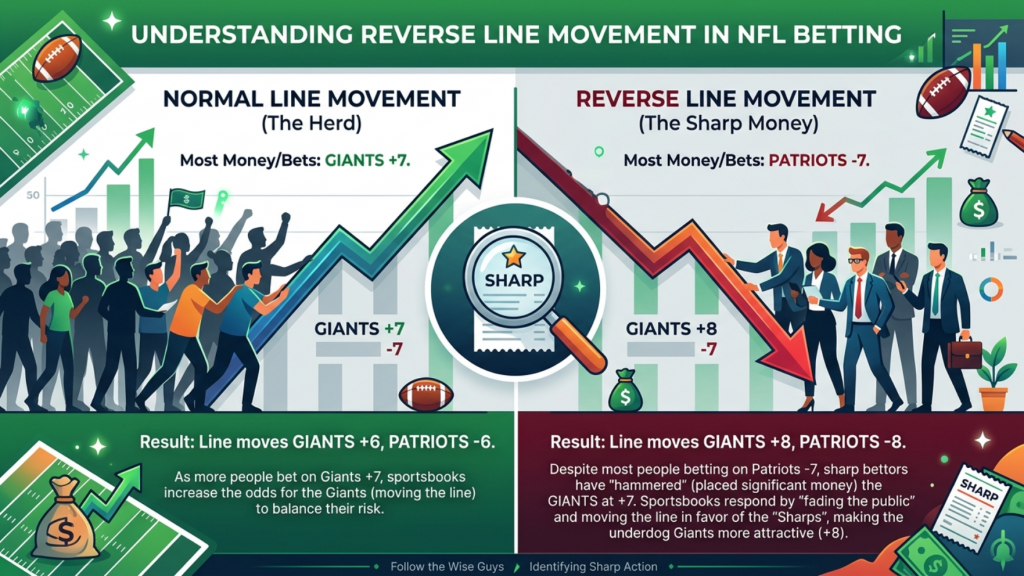
Reverse line movement is often caused by sharp bettors taking the other side of a bet, which can indicate that they have valuable information or insights that the general public does not. This can include things like injury reports, weather conditions, or team trends. Sharp bettors are typically professional bettors who have a deep understanding of the betting market and are able to make informed decisions based on their analysis. They often have access to advanced data and analytics, such as those provided by PFF or Next Gen Stats, which can help them identify value bets in the market.
Another key factor that can contribute to reverse line movement is public perception. If the general public is heavily betting on one side of a game, it can create an imbalance in the market that sharp bettors can exploit. For example, if a high-profile team like the New England Patriots is playing a lower-profile team like the Cincinnati Bengals, the public may be more likely to bet on the Patriots due to their brand recognition and perceived strength. However, if the Bengals have a strong defense or other factors in their favor, sharp bettors may see value in taking the Bengals and cause the line to move in the opposite direction.
It’s also worth noting that reverse line movement can occur in different types of bets, not just point spreads. For example, it can occur in moneyline bets, over/under bets, or even prop bets. This is because sharp bettors are constantly looking for value bets in the market, regardless of the type of bet. By understanding reverse line movement and how it works, bettors can gain a competitive edge in the market and make more informed decisions.
Identifying Reverse Line Movement
Identifying reverse line movement can be challenging, but there are several key indicators that bettors can look for. One of the most important is line movement itself. If the line is moving in the opposite direction of the majority of bets being placed, it could be a sign of reverse line movement. Another key indicator is sharp bettor activity. If sharp bettors are taking the other side of a bet, it can indicate that they have valuable information or insights that the general public does not.
More Read


Additionally, bettors can look for public betting trends to identify potential reverse line movement. If the public is heavily betting on one side of a game, it can create an imbalance in the market that sharp bettors can exploit. By monitoring public betting trends and line movement, bettors can gain insights into the betting market and make more informed decisions. It’s also important to note that reverse line movement can occur in different types of bets, so bettors should be aware of the specific bet type they are looking at.
Bettors can also use data and analytics to identify reverse line movement. For example, they can use historical data to analyze team trends and player performance. They can also use advanced metrics like DVOA (Defense-adjusted Value Over Average) from Football Outsiders to gain a deeper understanding of team performance. By combining these data-driven insights with market analysis, bettors can make more informed decisions and gain a competitive edge in the market.
Impact of Reverse Line Movement on NFL Betting
The impact of reverse line movement on NFL betting can be significant. If bettors are not aware of reverse line movement, they can end up making informed decisions that are actually misinformed. For example, if a bettor sees that the public is heavily betting on one side of a game, they may assume that the public is correct and follow the crowd. However, if there is reverse line movement occurring, the sharp bettors may actually have a better understanding of the game and be taking the other side of the bet.
More Read

Additionally, reverse line movement can affect the betting line itself. If sharp bettors are taking the other side of a bet, it can cause the line to move in the opposite direction, which can affect the value of the bet. For example, if the point spread is initially set at Packers -7, but the line moves to Packers -5 due to reverse line movement, the bettor’s potential winnings may be affected. By understanding reverse line movement and how it works, bettors can adjust their strategy and make more informed decisions.
It’s also worth noting that reverse line movement can be more pronounced in certain types of games. For example, divisional games or rivalry games may have more public interest and emotional betting, which can create an imbalance in the market that sharp bettors can exploit. By being aware of these market dynamics, bettors can adjust their strategy and make more informed decisions.
Comparison of Reverse Line Movement Across Different Bet Types
Reverse line movement can occur in different types of bets, including point spreads, moneyline bets, over/under bets, and prop bets. The impact of reverse line movement can vary depending on the specific bet type. For example, in point spread bets, reverse line movement can affect the point spread itself, while in moneyline bets, it can affect the odds of the bet.
Here is a comparison table showing how reverse line movement can apply across different bet types:
| Bet Type | Reverse Line Movement Indicator | Impact on Bet | Example |
|---|---|---|---|
| Point Spread | Line movement in opposite direction of public bets | Affects point spread, potential winnings | Packers -7 moves to Packers -5 |
| Moneyline | Odds movement in opposite direction of public bets | Affects odds, potential winnings | Packers -200 moves to Packers -150 |
| Over/Under | Line movement in opposite direction of public bets | Affects over/under line, potential winnings | Over 45 moves to Over 42 |
| Prop Bet | Odds movement in opposite direction of public bets | Affects odds, potential winnings | Aaron Rodgers over 250 passing yards moves to -150 |
| Futures Bet | Odds movement in opposite direction of public bets | Affects odds, potential winnings | Packers to win Super Bowl moves to +800 |
This table illustrates how reverse line movement can apply across different bet types, including point spreads, moneyline bets, over/under bets, prop bets, and futures bets. By understanding how reverse line movement works in each of these bet types, bettors can adjust their strategy and make more informed decisions.
Strategies for Dealing with Reverse Line Movement
There are several strategies that bettors can use to deal with reverse line movement. One of the most important is to stay informed about the betting market and line movement. This can involve monitoring public betting trends and sharp bettor activity to identify potential reverse line movement. Bettors can also use data and analytics to gain a deeper understanding of the game and make more informed decisions.

Another key strategy is to be patient and disciplined. If a bettor sees that the public is heavily betting on one side of a game, they may be tempted to follow the crowd. However, if there is reverse line movement occurring, it may be better to wait and see how the line moves before making a decision. By being patient and disciplined, bettors can avoid making impulsive decisions and make more informed choices.
Finally, bettors can use line shopping to find the best available line. If a bettor sees that the line is moving in the opposite direction of the public bets, they may be able to find a better line at a different sportsbook. By shopping around and comparing lines, bettors can get the best value for their bet and make more informed decisions.
Conclusion
In conclusion, reverse line movement is a key concept in NFL betting that can have a significant impact on the betting market. By understanding how reverse line movement works and how to identify it, bettors can gain a competitive edge in the market and make more informed decisions. Whether it’s point spreads, moneyline bets, or prop bets, reverse line movement can occur in different types of bets, and bettors need to be aware of the specific bet type they are looking at.
By staying informed, being patient and disciplined, and using line shopping, bettors can deal with reverse line movement and make more informed decisions. It’s also important to note that reverse line movement can be more pronounced in certain types of games, such as divisional games or rivalry games. By being aware of these market dynamics, bettors can adjust their strategy and make more informed decisions.
Frequently Asked Questions
What is the difference between reverse line movement and steam move?
A steam move is a sudden and significant movement in the betting line, often caused by a large amount of money being bet on one side of the game. Reverse line movement, on the other hand, is a situation where the betting line moves in the opposite direction of the majority of bets being placed. While both concepts can be related, they are not the same thing. A steam move can be a sign of reverse line movement, but not all reverse line movement is caused by a steam move.
For example, if a sharp bettor places a large bet on one side of a game, it can cause a steam move in the betting line. However, if the public is heavily betting on the other side of the game, it can create an imbalance in the market that sharp bettors can exploit, leading to reverse line movement.
How can I identify reverse line movement in real-time?
Identifying reverse line movement in real-time can be challenging, but there are several key indicators that bettors can look for. One of the most important is line movement itself. If the line is moving in the opposite direction of the majority of bets being placed, it could be a sign of reverse line movement. Another key indicator is sharp bettor activity. If sharp bettors are taking the other side of a bet, it can indicate that they have valuable information or insights that the general public does not.
Bettors can also use public betting trends to identify potential reverse line movement. If the public is heavily betting on one side of a game, it can create an imbalance in the market that sharp bettors can exploit. By monitoring public betting trends and line movement, bettors can gain insights into the betting market and make more informed decisions.
Can reverse line movement occur in other sports besides NFL?
Yes, reverse line movement can occur in other sports besides NFL. In fact, it can occur in any sport where there is a betting market and public betting trends. The key is to identify the specific bet type and market dynamics that are at play. For example, in NBA betting, reverse line movement can occur in point spreads or moneyline bets. In MLB betting, it can occur in moneyline bets or run line bets.
By understanding how reverse line movement works in different sports and bet types, bettors can apply their knowledge to make more informed decisions and gain a competitive edge in the market. It’s also important to note that reverse line movement can be more pronounced in certain types of games, such as playoff games or championship games. By being aware of these market dynamics, bettors can adjust their strategy and make more informed decisions.
Disclaimer: This article is published for informational and sports entertainment
purposes only. All statistical models, implied probabilities, historical trends, and line
movement examples discussed are based on publicly available historical data and analytical
frameworks. We do not provide commercial gambling services or real-money wagering.
Gambling involves risk. If you or someone you know has a problem with gambling, please contact
the National Problem Gambling Helpline at 1-800-522-4700 (US).