

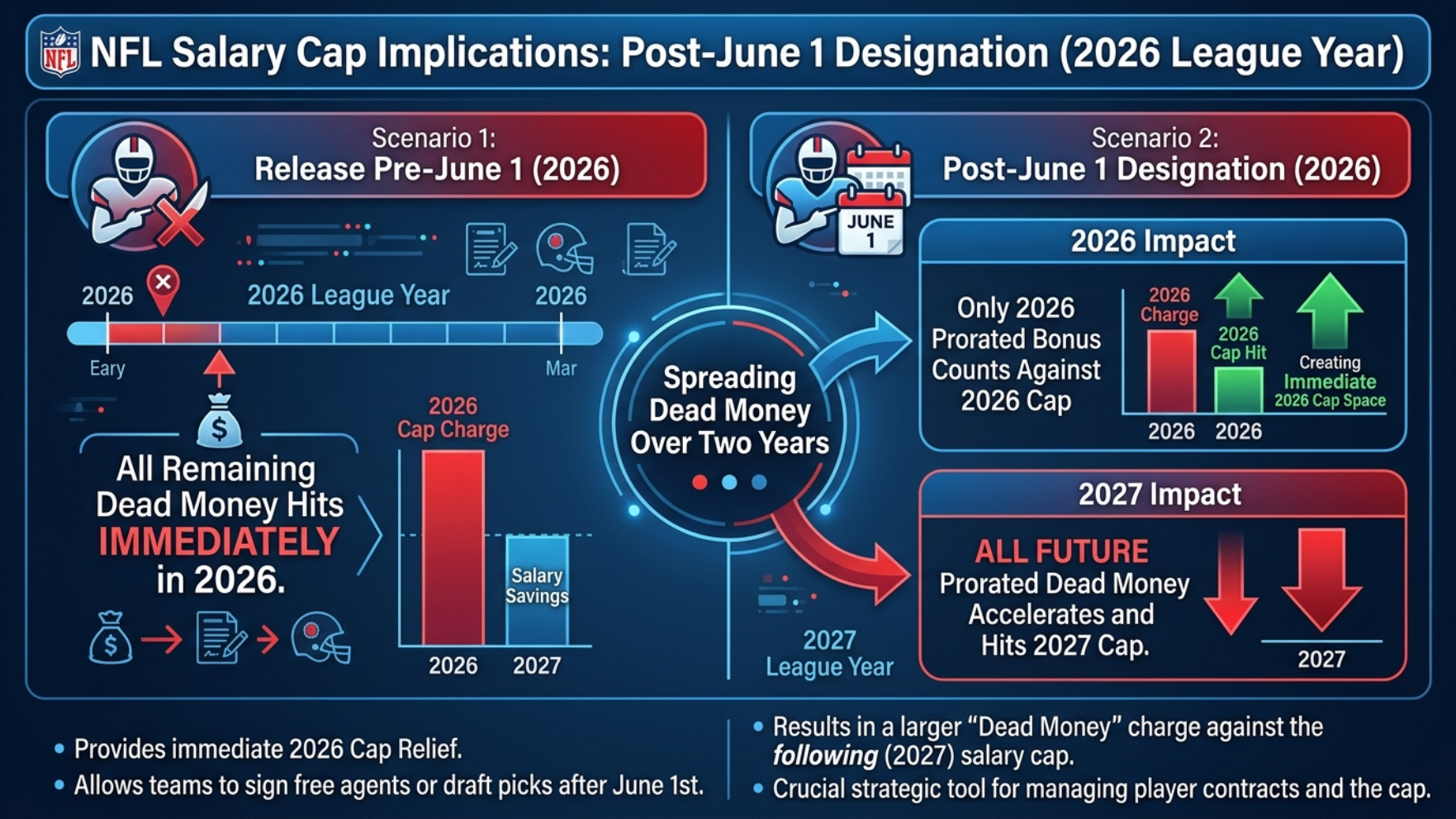
The NFL’s salary cap rules have a crucial date marked as June 1, which affects how teams handle player contracts and June 1 designation plays a vital role in this process. Under these rules, bonus proration from remaining or future contract years is delayed until the following league year when a player is released, retires, or is traded after June 1. This date used to be more significant, marking the beginning of the final wave of free agency, where teams would release players with excessive contracts or declining performance due to the change in salary cap implications.
The June 1 designation has been included in every subsequent collective bargaining agreement, including the current labor agreement, and it does not apply to trades. A majority of the time, when a player is traded or released, there is a residual cap charge, largely due to bonus proration, which is commonly referred to as dead money. This cap charge for a player who is no longer on a team’s roster is typically a sunk cost where money isn’t owed to the player.
NFL Salary Cap Rules and June 1 Designation
The Cleveland Browns, Green Bay Packers, Miami Dolphins, and Minnesota Vikings have used both of their June 1 designation options. The salary cap implications of these departures are significant, with the 2026 salary cap number being $56,267,647, and the 2026 dead money being $55.4 million, which includes a $15 million option bonus and $39 million 2026 base salary guarantee. The 2026 salary cap savings are $867,647, and the 2027 dead money is $43.8 million.


The June 1 designation has changed the way teams approach player contracts and roster moves. In the past, teams would release players with excessive contracts or declining performance after June 1, but with the current rules, teams can release players before June 2 and still benefit from the June 1 designation. This has led to more strategic roster moves, as teams try to manage their salary caps and make the most of their June 1 designation options.
June 1 Designation and NFL Teams
The NFL teams that have used their June 1 designation options have done so to manage their salary caps and make room for new players. The Cleveland Browns, for example, have used their options to release players with high contracts, while the Green Bay Packers have used theirs to make room for new signings. The Miami Dolphins and Minnesota Vikings have also used their options to manage their salary caps and make strategic roster moves.
The June 1 designation has significant implications for NFL teams, as it affects how they manage their salary caps and make roster moves. With the current rules, teams have more flexibility to release players and make room for new signings, which can lead to more competitive teams and a more exciting NFL season.
June 1 Designation and Player Contracts
The June 1 designation also affects player contracts, as it can impact how much a player is paid and when they are released. Players who are released after June 1 may have a harder time finding new teams, as most teams have already filled their needs through the NFL Draft and salary cap space is at a premium. However, with the June 1 designation, teams can release players before June 2 and still benefit from the salary cap implications.
The June 1 designation is an important aspect of the NFL’s salary cap rules, and it has significant implications for teams and players. As the NFL season progresses, teams will continue to use their June 1 designation options to manage their salary caps and make strategic roster moves.
NFL Salary Cap Implications After June 1
The NFL salary cap implications after June 1 are significant, as teams must carry the player’s full cap number until June 2, even though they are no longer part of the roster. The player’s salary comes off the books at that time, unless it is guaranteed. This means that teams must carefully manage their salary caps and make strategic roster moves to ensure they have enough space to sign new players and compete in the NFL season.
Frequently Asked Questions
What is the June 1 designation in the NFL?
The June 1 designation allows teams to release up to two players each league year before June 2, treating them under the salary cap as though they were released after June 1.
How does the June 1 designation affect NFL teams?
The June 1 designation affects how teams manage their salary caps and make roster moves, as it allows them to release players before June 2 and still benefit from the salary cap implications.
What are the salary cap implications of the June 1 designation?
The salary cap implications of the June 1 designation include carrying the player’s full cap number until June 2, even though they are no longer part of the roster, and the player’s salary comes off the books at that time, unless it is guaranteed.